Insights You Can Actually Trust. Cross-Checked, Not Just Generated.
Most "AI for analytics" tools run one model, once, and ship whatever comes back. Askalytics checks every answer against your actual data and runs it through several layers of checks, most of them plain code and math, so the number you read is a number you can defend.
Every number cited. Every answer checked.
AI is capable, but on its own it can stumble. It might confidently state a figure that doesn't add up, or drift off your data over a long conversation. For a tool you use to decide where real money goes, "the AI said so" isn't good enough. So Askalytics doesn't simply trust the model. Several layers check the work, and most of them are plain code and math, not AI checking AI.
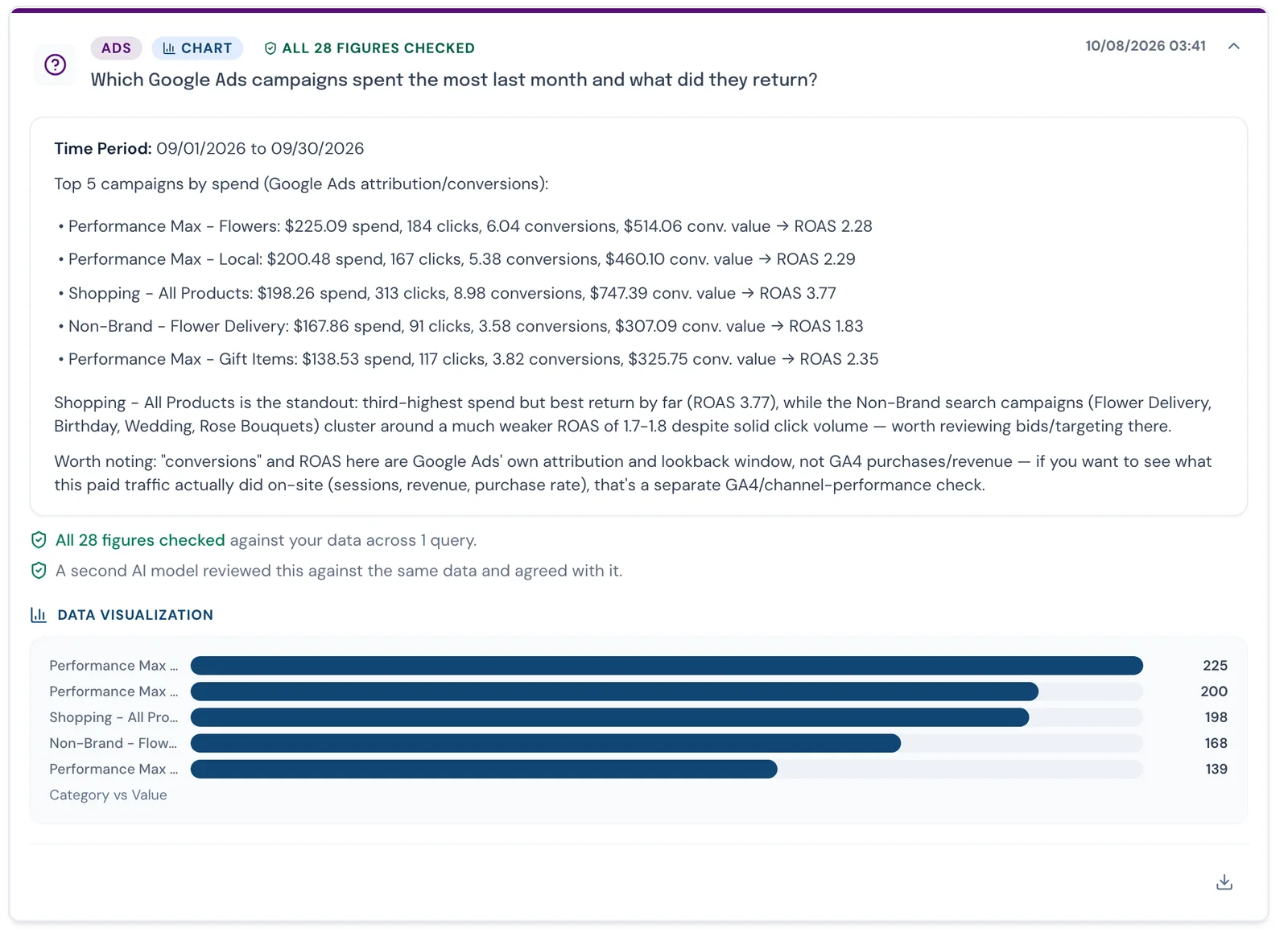
What a Checked Answer Looks Like
The figure check and the second AI review are printed on the answer itself.
Layers of Trust
An Independent Second Opinion
Every AI Insight, Scout brief, AI Lift plan and AI Audit is re-checked by a second, different AI model, which doesn't share the first AI's blind spots. Every Ask AI answer that uses your data is re-checked by a second, different AI model, never the one that wrote it. When the checks agree, that's a strong signal you can rely on. When they disagree, you see it flagged rather than buried. See how Confidence Check works →
Reconciled Against Your Real Numbers
The bigger layer is not AI at all. Every answer, insight and AI Lift plan goes through plain code and math checks that redo the numbers from your data. If a figure doesn't reconcile, it's corrected or flagged and the confidence score drops, so you see the risk instead of a silent miss. A quiet safety net for the moments an LLM gets confident about the wrong total.
Single-Shot by Design
Ask AI isn't a chat box. Every question is a fresh, data-bound query with no conversation history, so there's no thread to slowly steer the model off your data. No drift from one question to the next. Each answer stands on its own, tied to your actual numbers. See Ask AI →
We Check Your Tracking, Too
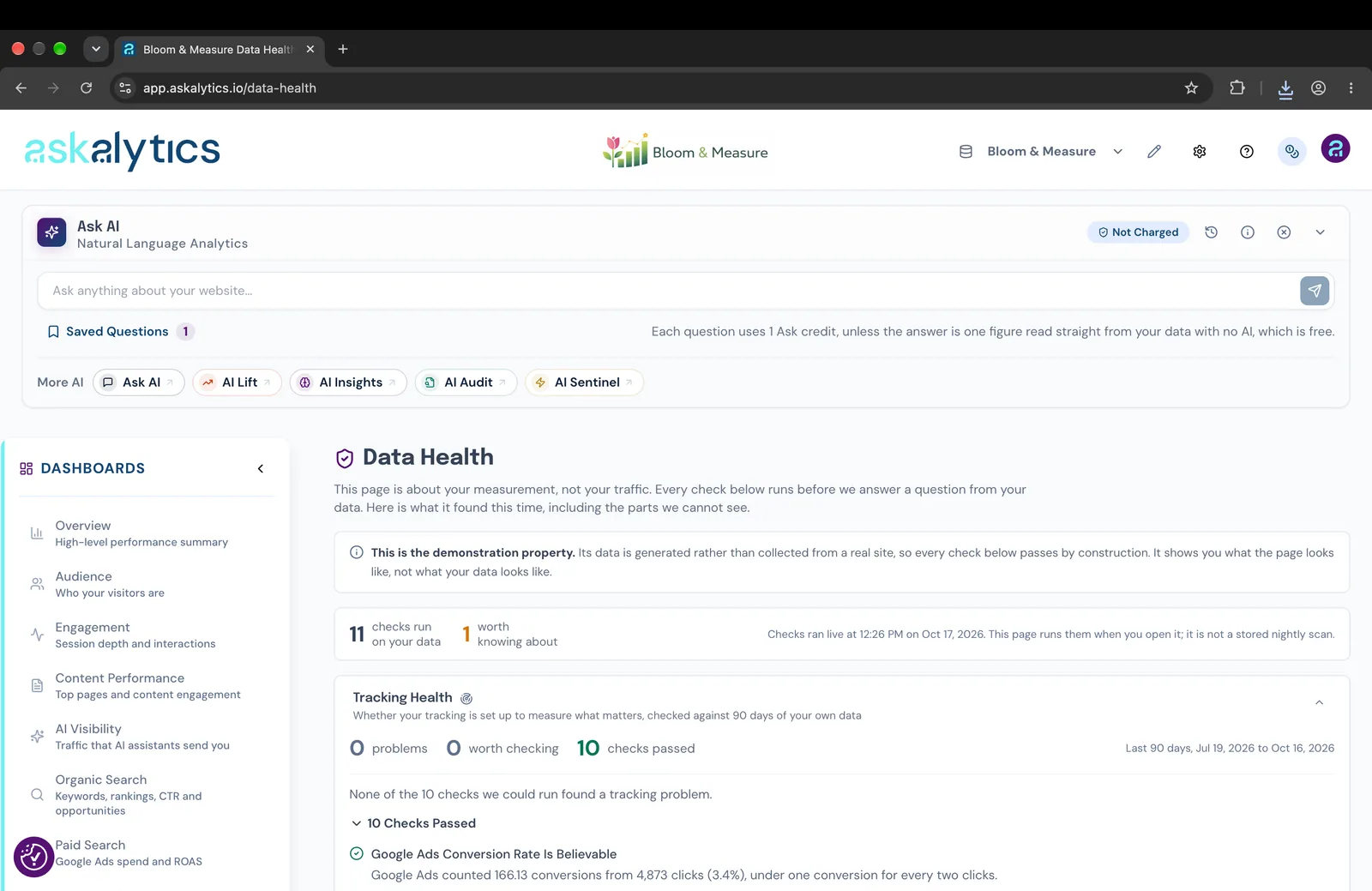
A perfectly checked answer is still wrong if the tracking behind it broke. So Askalytics checks the measurement as well as the math.
- Tracking Health reads 90 days of your own data and flags problems such as key events that stopped, test or development sites sending page views to GA4, and Google Ads claiming more value than your site sold.
- A check that cannot run is never counted as passed. It says "not checked" and why.
- Data Through dates on every dashboard show how recent the numbers are.
- Shareable answers carry their checks with them, so whoever you send one to can see how it was checked.
Why This Matters
The difference between an answer you read and an answer you can put in front of your board.
For a marketing leader presenting to a board, an agency reporting to a client, or a founder updating investors, a cross-checked insight is a defensible source. It comes with a verifier verdict, a confidence score, number-level verification, and citations to deterministic findings. That paper trail is built into every Askalytics insight. None of the major AI analytics tools do this. We built it because we believe single-model output isn't safe enough for decisions involving real money.
Trust Questions
It's the one layer that uses AI, on top of the code checks. Every AI Insight, Scout brief, AI Lift plan and AI Audit is re-checked by a second, different AI model, which doesn't share the first AI's blind spots. Every Ask AI answer that uses your data is re-checked by a second, different AI model, never the one that wrote it. When the checks agree, that's a strong signal; when they disagree, you see it flagged. See how it works →
No. Most of our checks don't involve AI at all. Plain code and math redo the calculations from your actual data, trace each figure back to it, and correct or flag what doesn't check out.
Ask AI is single-shot by design. Every question is a fresh, data-bound query with no conversation history, so there's no thread to slowly steer the model off your data. Each answer stands on its own, tied to your actual numbers.
Askalytics only reads from your sources and never writes to your accounts. Google Analytics and Search Console access is read-only. It connects to GA4, Search Console, Google Ads, and Microsoft Clarity, plus HubSpot and Mailchimp in beta, and delivers answers in Slack and Microsoft Teams, with Shopify coming soon.
A confident wrong answer and a correct one look identical. For a marketing leader presenting to a board, an agency reporting to a client, or a founder updating investors, a cross-checked insight with a confidence score and citations is a defensible source you can put in front of others.
Yes. Every Ask AI answer that uses your data is reviewed by a second, different AI model, never the one that wrote it. AI Insights, Scout briefs, AI Lift plans and AI Audits are reviewed by a second, different AI model too. Free simple lookups use no AI, and AI Sentinel alerts are checked by code only.
A set of checks on your tracking itself, run against 90 days of your own data. It flags problems such as key events that stopped or Google Ads claiming more value than your site sold. A check that cannot run is shown as not checked, never as passed.